
Industrial Dust Collector for Efficient Dust Collection
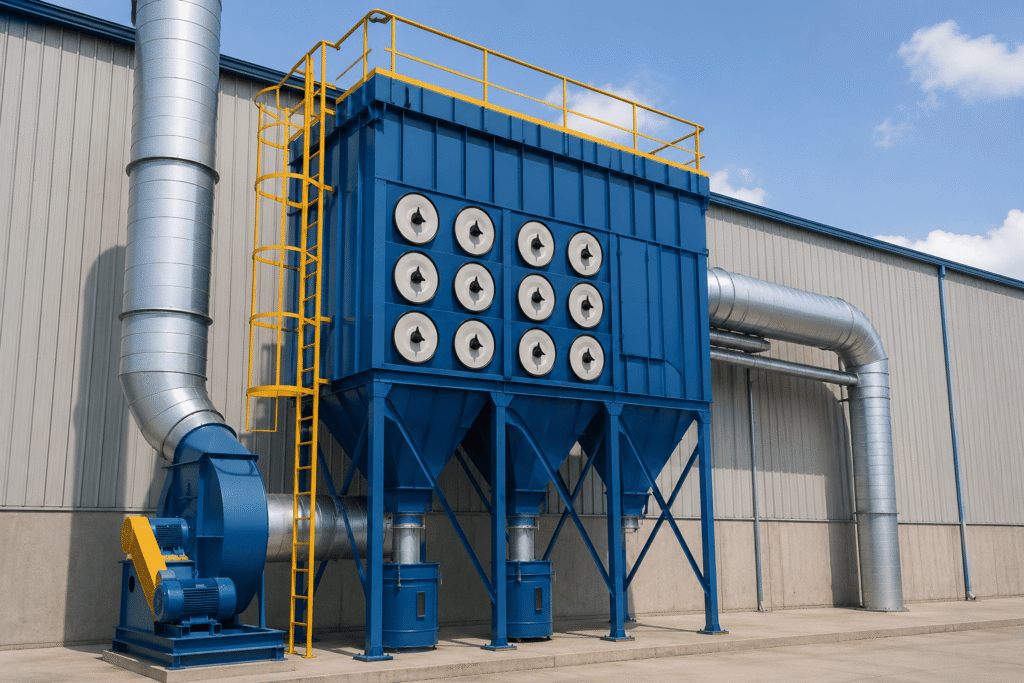
A Dust Collector is an industrial air pollution control system designed to capture and remove dust, fine particles, and airborne contaminants generated during manufacturing and material-handling processes.
What Is a Dust Collector?
A Dust Collector is equipment used to separate dust particles from an industrial air or gas stream. Dust-laden air is drawn into the collection system, where particles are separated using a suitable filtration or separation method. The cleaned air is then discharged or recirculated according to the system design.
Dust collectors are commonly used for processes such as grinding, mixing, cutting, conveying, powder handling, and material handling, where airborne dust can be generated.
How Does an Industrial Dust Collector Work?
1. Dust Generation
Industrial operations such as grinding, cutting, mixing, conveying, and material handling generate dust and airborne particles.
2. Air Extraction
A fan or extraction system draws contaminated air from the dust-generating process toward the dust collector.
3. Particle Separation
Dust particles are separated using a suitable filtration or separation method such as bags, cartridges, or cyclonic action.
4. Dust Collection
Separated dust is collected in a hopper, bin, or suitable discharge arrangement.
5. Clean Air Outlet
The treated air exits the dust collection unit through the clean-air outlet.
Types of Bag Filters

Bag Filter Dust Collector
Bag filter dust collectors use fabric filter bags to capture dust particles from an air stream. They are commonly used for industrial applications requiring continuous dust filtration.
Pulse Jet Dust Collector
A pulse jet dust collector uses short bursts of compressed air to clean the filter elements. This cleaning method allows the system to operate continuously while accumulated dust is removed from the filters.
Cyclone Dust Collector
Cyclone separators use centrifugal force to separate relatively coarse and heavier dust particles from an air stream. They are often used as standalone collectors or as pre-separation equipment before finer filtration.
Cartridge Dust Collector
Cartridge-type dust collectors use compact pleated filter cartridges to provide a large filtration area in a relatively small footprint. They can be suitable for applications involving fine dust and space limitations.
Portable Dust Collector
Portable dust collection units are designed for applications where dust extraction is required at different locations within a plant.
Key Features of Dust Collection Systems
Designed to provide effective separation of dust and particulate matter.
Equipment can be engineered for demanding industrial operating conditions.
System configuration can be optimized according to airflow, pressure requirements, and process conditions.
Equipment can be designed to suit available plant space and installation requirements.
Suitable cleaning mechanisms can be incorporated according to the selected filtration technology.
Properly engineered systems can facilitate inspection, cleaning, and routine maintenance.
Appropriate material selection and system design support reliable long-term operation.
Capacity, filtration method, fan arrangement, hopper, and dust discharge system can be configured according to application requirements.
Benefits of Using an Industrial Dust Collector
Helps capture airborne dust close to the point where it is generated.
Helps reduce airborne dust in production and working areas.
Helps minimize dust deposits around machinery and production equipment.
Helps reduce excessive dust exposure to machinery and associated equipment.
Supports cleaner and more organized industrial working environments.
Helps control airborne dust as part of an appropriately designed industrial dust management system.
Helps manage particulate matter released from industrial processes.
Properly designed dust collection can support stable production conditions.
High-Performance Dust Collection Solutions
Elenor offers customized Dust Collector systems that are designed according to the client’s process requirements, airflow capacity, and dust load conditions. Our systems are manufactured using high-quality materials and modern engineering techniques to ensure reliable and long-lasting performance.
We provide different types of dust collection systems including:
- Bag Filter Dust Collectors
- Pulse Jet Dust Collectors
- Cyclone Separators
- Cartridge Type Dust Collectors
- Portable Dust Collection Units
- Industrial Fume & Dust Extraction Systems
Our solutions are suitable for both small-scale and large industrial applications. The systems are designed for easy operation, low maintenance, and maximum dust separation efficiency.
How to Choose the Right Bag Filter?
Choosing the appropriate dust collector requires an understanding of the actual process, airflow requirements, and dust characteristics.
- Airflow requirement
- Dust concentration
- Particle size
- Type and density of dust
- Dust temperature
- Moisture content
- Required filtration performance
- Filter media
- Cleaning mechanism
- Available installation space
- Dust disposal method
- Operating and maintenance requirements
Dust Collector vs. Dust Extraction System
| Dust Collector | Dust Extraction System |
|---|---|
| Separates and collects dust from an air stream | Complete arrangement for capturing and transporting contaminated air |
| Main filtration/separation equipment | Includes multiple system components |
| May include bags, cartridges, cyclone, etc. | May include hoods, ducting, fans, collector and discharge |
| Focuses on dust separation | Focuses on complete dust capture and transportation |

Applications of Industrial Dust Collectors
- Cement Plants
- Chemical Processing Units
- Pharmaceutical Industries
- Food Processing Plants
- Textile Industries
- Woodworking Industries
- Metal & Fabrication Industries
- Powder Handling Systems
- Boiler & Furnace Applications
- General Engineering & Manufacturing
Frequently Asked Questions
What is a dust collector?
A dust collector is an industrial system used to capture and separate dust and airborne particulate matter from contaminated air.
What is the main purpose of a dust collector?
Its main purpose is to control airborne dust, improve workplace air quality, protect equipment, and support industrial pollution-control requirements.
Where are dust collectors used?
Dust collectors are used in cement, chemical, pharmaceutical, food, metal, textile, woodworking, powder-handling, boiler, furnace, and engineering applications.
Which type of dust collector is suitable for fine dust?
The suitable system depends on particle size, dust concentration, airflow, temperature, and other process conditions. Cartridge and bag filter systems are commonly considered for fine-dust applications.
Can a dust collector be customized?
Yes. Dust collectors can be designed according to airflow capacity, dust load, process requirements, filtration method, available space, and dust disposal requirements.
How often should dust collector filters be cleaned or replaced?
There is no universal replacement interval. Filter condition should be monitored based on pressure drop, cleaning performance, dust loading, visible damage, and overall system performance.
What industries need industrial dust collection?
Industries generating airborne dust during grinding, cutting, mixing, conveying, powder handling, material processing, and similar operations can benefit from an appropriately designed dust collection system.
Conclusion
An Industrial Dust Collector provides an effective way to control dust generated during manufacturing and material-handling processes. The right combination of collector type, filtration media, airflow, cleaning mechanism, and dust-discharge arrangement can provide reliable dust separation and cleaner industrial operations.
For effective performance, the system should be selected according to the dust characteristics, airflow requirement, particle size, process conditions, filtration requirements, and plant layout.